Wednesday, June 30, 2010

Israel Day 15: Boat Ride, Visiting the Jesus Boat, Churches, Rock Hyrax, and Arbel!

Here's my impression report for yesterday. It was quite an eventful day!

The first stop of the day was the one I was the most excited about for the whole Galilee trip. The prospect of a boat ride on the Sea of Galilee just sounded like so much fun! I’ll even admit that I was secretly hoping that a storm would suddenly blow in so we could experience a taste of what the disciples felt. Then we were told that storms have caused waves as high as ten meters on the Sea of Galilee. I can live without experiencing waves that high on a body of water that small!
Yar! A photo of the inside of our sturdy seafaring vessel.

The boat ride was indeed a blast, and the boat was actually bigger and nicer than I expected. The highlight of the boat ride for me was when one of the men from the crew demonstrated the use of a castnet. The net he used was similar to what would have been used in the first century, but it was made out of different material. Instead of being made of rope for the net and stones for the weights, it was made of nylon for the net and metal weights. It was still interesting though.

A deckhand demonstrates how to throw a cast net


The location we docked at is the home of the Jesus Boat. This is a boat that was discovered less than 30 years ago. It seems to be from the first century, and is remarkably intact. This is the kind of boat that Jesus and the disciples would have used on the Sea of Galilee. My only disappointment in the exhibit was that they didn’t spend much time discussing how they preserved the boat. It soaked in a pool of chemicals for years, but I really wanted to know what kinds of chemicals. This is something I’ll have to look up later. The way the boat was displayed was absolutely stunning. I really enjoyed the way they used sandblasted pieces of glass cut in wavy patterns to mimic water. The blue lighting really enhanced the effect. It was a very creative and well done exhibit. I just wish I had thought to bring a tripod on this trip just so that I could have gotten a decent picture of the boat and exhibit. Oh well, live and learn.


The Jesus Boat. I had to use a flash so the picture is very washed out. The actual exhibit is much, much prettier

Next on the agenda was a visit to two different churches. This is really what I needed at this point in the trip. We first went to a church that celebrates the miracle of Jesus feeding the 5,000. The church was one of the most peaceful I’ve ever visited. The church had some beautiful mosaics that were a joy to view. It was a great place just to spend a few minutes in prayer.
Theo courtyard outside the church. The pond below the olive tree has a bunch of koi in it!

We then moved on to the church that commemorates (and claims to be the location of) Jesus giving the Beatitudes. The sisters there had reserved us a location where we were able to have a short worship service. We sang a few songs, and then McKenzie shared with us a few thoughts on the Beatitudes and visiting the Holy Land in general. We were then given 45 minutes to wander around the grounds of the church as well as the church itself. This came when I needed it most. This trip is very intensive and tiring, and the focus is mainly on academics. Even though we get a handful of free days or afternoons, we have to spend most of them studying for our exams and doing map work. The 45 minutes we had at this location gave me a time when all we had to do was enjoy the gardens and spend time in prayer and contemplation. Up until this point, I had been getting more and more worn out and the trip was starting to be a chore rather than a joy. This little bit of time given to us helped me to refocus my priorities for the rest of the trip. I only wish we had gotten a chance to experience this sooner.

Just one photo of the beautiful gardens at this church.


The best part about the visit to Chorazim was that there were a bunch of rock hyraxes there. I’ll take a moment to admit that I have no idea what the plural of hyrax is. Anywho, there were a bunch of them and I was able to not only see them in the wild but also get a few pictures of them. This was incredibly exciting for me because the one animal I really wanted to see in Israel was a rock hyrax. Not only did I see one of them, I got to see a bunch. They were everywhere!
Isn't this a cute rock hyrax?

The last stop of the day was the cliffs of Arbel. We had tried to stop here on our first day, but we were just late enough getting there that we weren’t able to see it then. We hiked over to the top of one of the cliffs to discuss what we could see and to admire the view. I say we walked over because we were already nearly to the top of the cliff when we parked the bus. The hike the rest of the way to the top was short and the ascent was minimal. Then we were given the option to walk back to the bus or to take an hour long hike.

I opted for the hike. I was smart enough to take two liters of water with me. This ended up being a very good thing, even though it made my backpack heavier than I would have liked. The hike down was fairly steep with us having to climb down small metal rungs at times. Part of me kept thinking that this was crazy. Thankfully, I continued on. By the time we finished our descent, I had already torn through liter number one of water and was wishing I had brought three liters with me instead of just two. It didn’t help that it was 40°C (104°F). If I had known it was this hot, I might have opted to go back to the bus rather than hike. Thankfully, there was a bit of somewhat flat ground to walk on for a while, which was a nice break from climbing down. There were all kinds of caves that Jewish men hid in at one point when they were defying Herod. They were pretty interesting to see. Finally we came to the point where we needed to start climbing back up the cliff.
Arbel is lots of fun. Really!

This was the part I had been dreading. Initially, we had a fairly steep hike up that was longer than I expected. Then we came to the point where hiking up a nice trail was no longer really an option. It was time to start climbing back up the cliff. Thankfully, the park service is kind enough to put in big metal rungs and cables that you can hang onto and step on (in the case of the rungs that is). If the climb had been much steeper or if those rungs hadn’t been there, I would have been looking for a harness and climbing rope. Overall, the climb back up wasn’t too terrible. At least it wouldn’t have been if it hadn’t been so hot outside. By the time I made it back to the bus, I had consumed all the water I had and was wishing we hadn’t already used up the rest of the water on the bus. I was very thankful to get back to En Gev and get more water.
The capstone to the whole day was getting back to the resort at En Gev earlier than we expected. This was great because it meant we had time to change into our swimsuits and go swimming in the Sea of Galilee for a while before supper. After hiking in 104°F temperatures, swimming in the cool, calm water of the Sea of Galilee felt amazing. I had initially planned to go swimming again after supper, but the post-Arbel swim was so wonderful that swimming again would have just been disappointing.

The final event of the day was a worship service on the shore of the Sea of Galilee that Dr. Richter had put together. Dr. Stone and Laurie White took turns leading us in some songs. In between these, several people shared testimonies of how God is working in their lives, or epiphanies and insights God had given them during this trip. It was a great time of worship and praise, and really helped to sum up our trip thus far. I walked away from that service thinking that if we had ended the trip right then and there, I would feel like this trip had been worth it. Everything else to come is just icing on the cake.

This picture was taken the day before. It's just too pretty not to use

Monday, June 28, 2010

Israel Day 14: Hazor, Dan, and the Golan Heights

I don't really feel like posting pictures tonight. I might come back and add them later. But here's the impression report.

Today we started off the day heading to Hazor. This was a location I had heard a lot of people talk about, but I didn’t know much about it. One interesting thing about it is that it is a very large tel (mound) which means it was probably a very large city. The tel is over 200 acres. This is huge, especially when compared to places like Jericho which is only seven acres. There were two things I found interesting there.
The first is that Hazor is currently an active dig site. There were people doing excavations while we were walking around. This was interesting especially because we got to talk with someone who has excavated there for several seasons now. Honestly though, my main initial impression was that it’s another antiquities site that has had some reconstruction done to it, but it’s till an antiquities site. There were a few interesting things there, but overall, it’s already run together in my mind with most of the other tels I’ve been to.
The second interesting thing that happened there for me was that I spotted a rough tailed agama while Dr. Rasmussen was talking about something (I think it was a storehouse). I lifted up my camera and managed to get one shot of it before I was yelled at for taking a picture while he was lecturing. To be perfectly honest, I was really annoyed by that. Agamas are not terribly common lizards to see when there are so many people around. Compound that with the fact that the rough tail agama only occurs in part of Israel—a part I’m only in for a few days—and the agama had my sole attention. The tel has been there for thousands of years and it will probably continue to be around for many more. That agama will not be. That means to this point, I’ve seen ibex, two different frog species whose pictures I need to check against a field guide to be sure what they are, several bird species (mainly pigeons and doves though), a spider I have yet to identify because the only field guide for it I’ve seen so far was in Hebrew, and a lizard I only saw the tail of so I’m not sure what it is. I was hoping to see more wildlife here. I guess I’ll just have to keep my fingers crossed!
One of our next stops was Tel Dan and the nature preserve there. The nature preserve was absolutely beautiful. I wish we had been able to spend more time walking through a few of the trails to hopefully see the wildlife instead of rushing through it all to get to the antiquities site. I recognize that the antiquities sites are important, and there was some fascinating stuff there, but there’s really something to be said for enjoying God’s creation. Man’s creation is interesting, but I find God’s far more magnificent. That’s why I’m so glad to be able to spend some time here sitting on the shore of the sea of Galilee watching the water and sky and listening to the waves lap against the shore.
The main part of the antiquities component of Tel Dan that I found interesting was listening to Dr. Richter talk about site B which she and Dr. Stone, along with some students from Asbury, helped excavate. The most fascinating part of her talk was when she was talking about the Muslim graves they excavated as part of that site. The anthropologist that worked with them there was able to estimate the ages of the people buried there fairly accurately. Not only that, but the anthropologist was able to determine things like how well they ate and how hard they would have worked by closely examining the skeletons. This makes the site more real because it gives it a face (well, skull really) and some form of an identity. It made the site more human to me.
Visiting Qasrin was an interesting site because of all the reconstruction done. We got to go in a reconstructed house to see how a family might have lived several thousand years ago. The most moving part of this was listening to Dr. Richter talk about how in a given family, everyone would have known everyone else’s business because they all lived in such close quarters. Not only that, but everyone in the community knew everyone else’s business. Isaiah uses an analogy at one point of a women in labor who is losing all of her strength and cannot birth a child. In this situation at that time, that was a death sentence for both mother and child. Dr. Richter went on to talk about how when a woman first went into labor, the whole community would be aware of what was happening because of her cries and the activity of the family. As she started to lose her strength the community would realize this and they would know when she died. When this happened, this was not a loss just for the family, but for the entire community. This was absolutely heartbreaking, and it served to put make Isaiah’s analogy become more real. This passage came alive to me like it never had before.
At the tail end of the day, we stopped by Bethsaida to have a quick look around. This site was interesting mainly because what we visited is called et-Tell. The reason for this is that we’re not sure that this is the location of Bethsaida. It seems to be a good candidate, but it’s anything but certain. It showed me just how difficult it can be to be certain of the physical location of a place mentioned in the Bible. Names change over time, and as this happens, some names get lost to history. Bethsaida is one of those sites.
Overall, today was a good day that allowed me to see more of God’s beautiful creation. It’s really helped me to feel more of a connection to events in the Bible and the locations at which they took place.

Sunday, June 27, 2010

Israel Day 13: Caesarea, Mt. Carmel, Megiddo, and the Sea of Galilee

After spending so much time in Central and South Israel, I was looking forward to see the Northern part of Israel. I was especially excited to see the Sea of Galilee. I’ll even admit that I was a little bit bummed that we would be visiting other locations first.
I was unsure of what to expect with Caesarea. I knew it was an important sea port in its day and is mentioned in the Bible some, but I didn’t really know anything about it. I’ll even admit that the prospect of yet another antiquities site with a bunch of ruins that mostly look like other ruins was not appealing to me because I’m not an archaeologist and I’ve never taken an archaeology class. Caesarea was a welcome change from the expected. Like Masada, it’s had a great deal of reconstruction work done on some sections. This allowed me to get a better idea of what it looked like back in the first century. Even better, they had some excellent marble statues as well as other architectural pieces on display. I’ve been lucky enough to see some marble statues in art museums, but it was another experience entirely to see different statues in a context that is starting to approach the context of where they would have originally been displayed. It’s still not the same, but it brings the appreciation to a whole new level.

A marble statue of a man with a lamb around his neck

The major highlight for me there was walking around the kurkar rocks that made the foundation for the lower part of the palace as well as the swimming pool. The best part of it was that the Mediterranean Sea was splashing up onto the rocks filling the remnants of the swimming pool as well as creating all sorts of tidal pools in the eroded rocks.

There were small fishes, arthropods, and even one nice size dead crab in one pool. Granted, the crab was indeed dead, but at least I got to see some Mediterranean Sea critters up close and personal. Even if one of them—the crab—won’t remember it.

Me and a dead crab

Next we mosied over to the aqueducts. This was far more exciting for me than I ever would have expected. I’ve seen lots of pictures of aqueducts, but this was my first time to experience them up close and personal. The best part was that we were even allowed to climb on top of them! As I was walking down, the thought that kept popping into my mind was that people would have constructed these by hand. They’re an impressive feat of engineering. The only down side to walking along the top of them was that at some point I had to climb back down. It didn’t occur to me that I’d probably have to jump down the last six feet since down climbing them would seem pretty difficult. In retrospect, down climbing probably would have been the better option. Oh well, live and learn I guess.
First thing in the morning on the way to Caesarea, we had a worship service on the bus with Dr. Stone leading us in some songs. After the music, several of the students did a dramatic reading of 1 Kings 18 which is the story of Elijah having a showdown with the prophets of Baal on Mount Carmel. After the reading, Dr. Richter shared a few thoughts on the passage. The reason for picking this passage is that our next stop after the aqueducts was the Muraqa Sanctuary and Monastery.

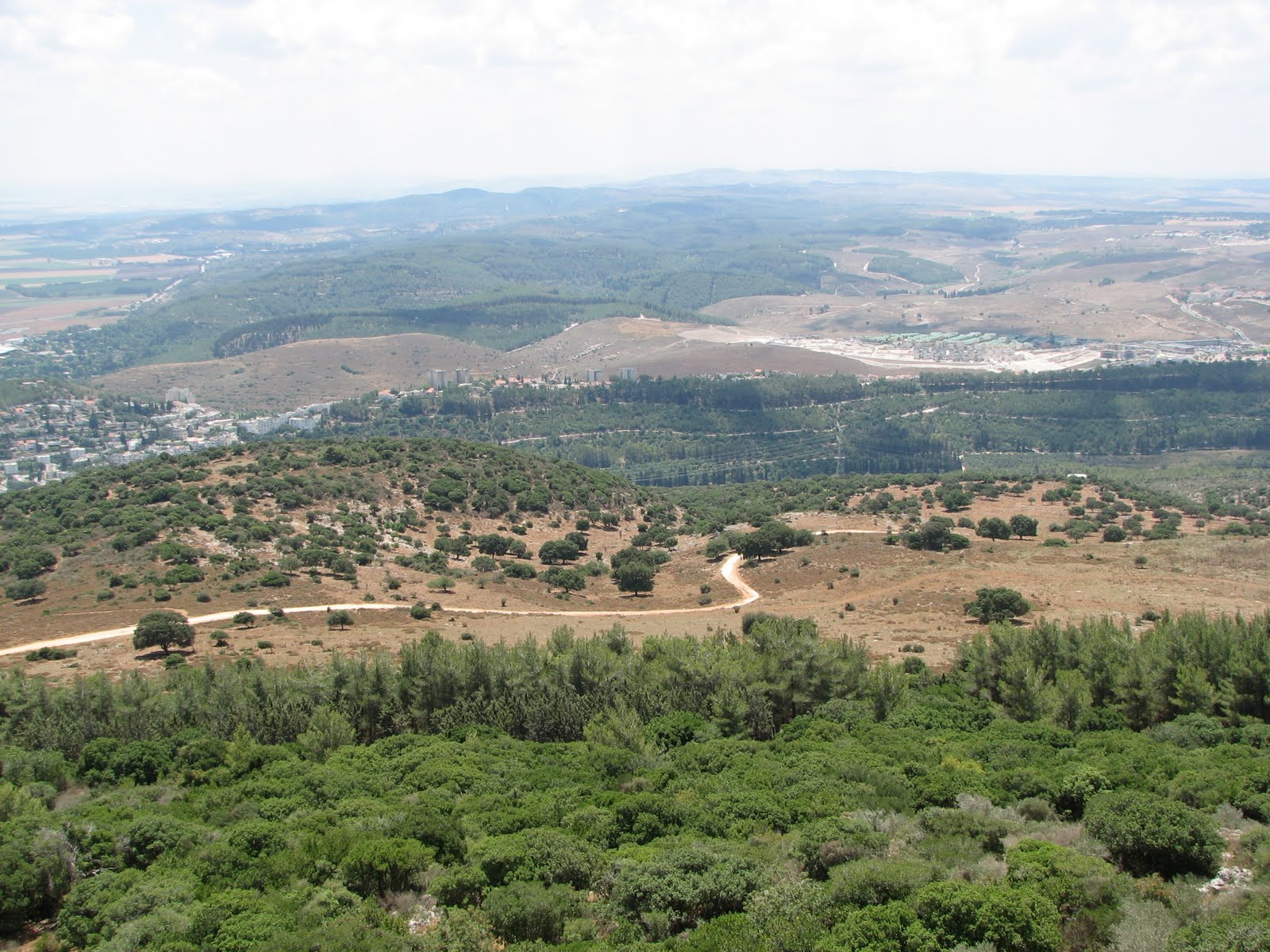
A view of the Jezreel Valley as seen from the top of Mt. Carmel

This monastery is located at the top of Mount Carmel and is located at the traditional place of Elijah’s showdown with the prophets of Baal. The first thing I noticed is that Mount Camel isn’t as tall in real life as it is in my mind. If we had not been able to take the bus up there but rather walk it instead, I’m sure I would have a slightly different opinion of this. But still, I expected it to be much taller than it is. The second thing I noticed is that you can see most of the Jezreel valley from up there. The topographical maps I have show this, but it’s far more dramatic in real life. It was quite impressive. Seeing the location of this even really makes it more real to me. The story just seemed to come alive to me when I was up there. Other sites have helped me have a better appreciation for the events that took place on or near there, but this one was really dramatic for me. Having read the full Biblical account ahead of time probably didn’t hurt either.

Driving down the road, we stopped for a moment so Dr. Rasmussen could point out to us a well preserved rolling stone grave. We didn't get out of a bus, but here's a picture I took


We visited Megiddo. The main highlight there for me was seeing an actual manger that would be similar to what Mary would have laid Jesus in. I've included a picture for those who are curious...


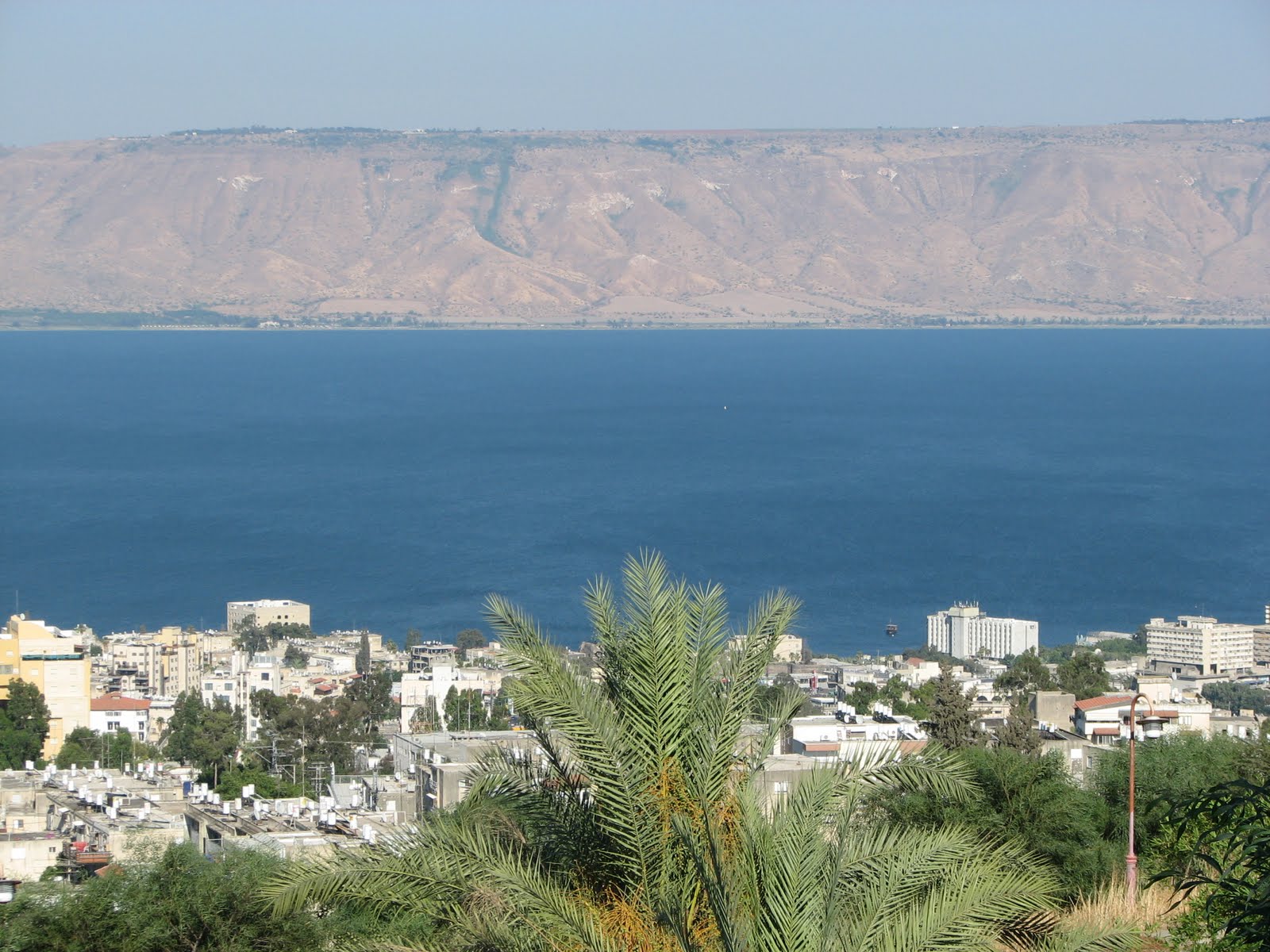
After a failed attempt to visit Arbel (the park had already closed by the time we got there) we went ahead and drove over to Tiberius. Tiberius is one of the cities located on the shore of the Sea of Galilee. They have a nice overlook that gives a great view of most of the Sea and it also happens to be almost directly across the Sea of Galilee from where we’re staying at night. This allowed us to get a brief preview of the resort at En Gev at which we would be staying. The first thing that really struck me about the Sea of Galilee is just how small it is. I knew it wasn’t huge, but it’s still smaller than I had anticipated. A more appropriate name for it is probably the Lake of Galilee, but I’m no expert on that.

The Sea of Galilee as seen from an overlook at Tiberius
The resort we are staying at in En Gev was the biggest surprise of the day for me. Dr. Rasmussen had told us that it was a nice location on the Sea of Galilee, but his brief description did not do it justice. The bungalow Jeremy, Sam, and I are staying in is as close to the shore as you can get here.

My bungalow at En Gev. Good old number 104!

It’s a 30 second walk from our door to the water. Even better, the resort faces west which means we saw the sun setting over the Sea of Galilee. To top it off, towards the end of the sunset, some of us went swimming so we we’re swimming in the Sea of Galilee watching the sun slowly drop below the mountains on the other side. It was the most amazing sight I’ve seen yet in Israel. As I sit here writing this, I’m sitting just above the beach listening to the waves lap at the shore staring off into the lights of Tiberius on the other side. I feel like I could stay here forever. I’m so glad we get to spend three nights here!

Sunset over the Sea of Galilee

Saturday, June 26, 2010

Israel Day 11 and 12: Free day, studying, test, homework, and free time!

Yesterday (Friday) was a free day for our class, which means it's time to study for the test the next morning. Before studying though, we got to go on a field trip that Dr. Richter had arranged for us. I'm not quite sure who initiated it, but we were invited to Hebrew Union College to go on a private tour of the Skirball Museum. When I inquired the day before what was at the museum, Dr. Richter replied, "Old stuff!" That's good enough for me, so off we went to the Skirball Museum.
Either we're getting a bit more used to walking up and down hills, or the walk was not as bad as expected because we arrived 20 minutes early.

The Museum did indeed contain lots of old stuff. They had quite a few artifacts (mainly potter) from Tel Dan, Tel Gezer, and Tel Aroer. I was excited to see some real pottery up close and personal. At almost every antiquities site we've been too, we've seen scads of pottery shards, but alas no full pottery pieces. Whatever little museums may be attached to the sites typically have only contained reproductions. It was awesome to see so many jars, vessels, and other pieces made out of pottery. They even had a bathtub and a pottery sarcophagus! The best part was that we could touch just about everything. The professor who led our tour commented that it was all just rock and fired pottery. The only way we could really damage any of it is if we smashed it.

The tour of the Skirball museum was Skirballrific, but it wasn't long before studying for the upcoming test became a priority. It's hard to believe that it was only on Monday that I was sitting down to take a test. I'd love to say studying was fun, but it's still studying so...

A group of us had planned to take a study break after supper (I know, supper is also a study break) and head to the Wailing Wall to see what it was like just before the beginning of Shabbat. We had been told it was worth the time to go see all of the people gathering to worship, pray, and celebrate the beginning of Shabbat. We made it there about 7:45 (45 minutes or so before sundown) and it was pretty packed. There was a heavy military presence, but many of them seemed to be there to also celebrate. We made our way over to the wall that separates the rest of the area from the Western Wall to watch what was going on. We stopped at the women's side first because we heard a lot of singing. Groups of women were standing in circles dancing and singing very jubilantly. It sounded beautiful and was an awesome sight to watch. After a few minutes, we wandered over to the men's side to watch the happenings. Two guys were being carried around on shoulders and the rest of the activity closely mirrored what was happening on the other side. It was like one big worship party!

Two things I found really fascinating were watching what the men were wearing, and watching the teenagers and young adults. There was a wide range in the clothing the men wore from jeans and t-shirts to suits and hats to even fancier clothes. Some guys looked like they were wearing black silk bathrobes. I joked that I needed a field guide to understand what different outfits mean. Really though, it's not totally a joke. I think I need to do some more reading on modern Judaism.

The young people were really interesting to watch. It seemed that they were at a major social event. In reality, they were. After all, many of us find church to be a social event. It was just surprising to see "kids" who were 18 and 19 standing there in clothing that is fairly western, but with semi-automatic weapons slung over one shoulder.

After a trip to the Western Wall, it was time to mosey back to JUC and get back to studying. After class and our test today, I did a little bit of homework, took a nap, and then went to the Old City with Joel Bonner to wander around and buy some snacks for our next trip. We each got a variety of dried fruit and enjoyed looking in the various shops. It's so cool to only be a 10 minute walk (if I'm taking my time) from the Old City. It'll be nice to have a lot of next weekend to shop and explore it some more.

Friday, June 25, 2010

Israel Day 10: Masada, The Dead Sea, En Gedi, and Qumran


Here is my impression report from the last day of our trip to the southern part of Israel.

I was unsure of what to expect from Masada. I didn’t really know anything about it, but I had heard the name some both in the required map work for this course as well as in reference to a tough hike. One of the t-shirts I’ve seen for sale all over the place is “I climbed Masada,” or some variation of that. This intimidated me, or at least it did until the wadi walk the day before. After that climb, I felt like I could handle anything thrown at me for this trip. Or, at least that’s how I felt until I saw the siege ramp we would be walking up. It was quite a bit bigger and steeper than I had expected. Thankfully, the path we took is on the side of the siege ramp and has steps built into it. This may be the first time I was actually thankful to see stairs in Israel because they meant that I didn’t have to scamper up that steep incline.

See the tiny white line on the left side of the giant mound of dirt? That's our path up to Masada. The giant mound of dirt is the original Roman siege ramp completed in 73AD

The hike up ended up being easier than I expected, although it was still immensely tiring. At the top, I was greeted with a fantastic view of the surrounding area, a beautiful antiquities site, and most importantly some shade and a bottle of Coke! I had questioned the wisdom of carrying up a bottle of coke with me, but I’m glad I did. It was a great way to celebrate my success. The first thing I really noticed about Masada was just how nice it is. Most of the antiquities sites we’ve visited up to this point don’t receive a lot of visitors and it’s mostly just a bunch of remains from archaeological digs. There’s typically been some work done to give us a better idea of what the site originally looked like, but this usually involves just adding a few courses of stones to the walls or repairing an arch that is falling down. Masada is different.
Me standing on the lower tier of Herod's Northern Palace at Masada. The pillars behind me are partly reconstruction. Originally they were solid marble.


There has been a lot more work put into it. There’s various models scattered around the site to help explain different areas of the site. There’s plenty of nicely shaded areas under which we could gather so that Dr. Rasmussen could explain things to us. I understand that this site is very important to many people, and it showed. While we were there, I saw at least one worship service going on, and I think I saw a Bar-Mitzvah starting up. It was just nice to visit an antiquities site that was so nice, and that you could access by other means besides walking up and down large hills or sets of stairs. The cable car ride down was most excellent!

An aerial view of the Snake Path leading down from Masada. The people in the picture are all from my group. I was riding comfortably in the cable car overhead...

After Masada, we got back on the bus to head off to an activity I had really been looking forward to: swimming in the Dead Sea. We were only given about 15-20 minutes to swim in it, but we were told this would be more than enough time. I was doubtful about this just because I love to swim. I had forgotten that Dr. Richter had described swimming in the Dead Sea as, “Swimming in Italian salad dressing.” She was not kidding. It was an incredibly bizarre feeling. And the density of the water made it so easy to float that I actually got tired of laying there after a few minutes. Not to mention that the high salt content found a couple of small cuts and scraps on my arms and legs I didn’t realize I had. It was a great experience though, and I’m glad we got the opportunity to try it out.
A group of us swimming at the dead sea. I'm the one with the floppy hat and the shirt. No sunburn here!

As awesome as this was, I couldn’t wait to get to En Gedi. Dr. Richter had told me it was one of her favorite places in Israel. En Gedi is an oasis in the middle of what is mostly desert. Granted, the Dead Sea is nearby, but its water is not potable. Walking along a dry dusty wadi and suddenly stumbling upon this oasis was amazing. We had been in the desert for several days at this point. Granted, we had experienced the water at En Avdad and the Dead Sea, but En Gedi was something else entirely. There were lush plants everywhere, and the number of birds singing was nothing short of incredible.

Some of the waterfalls cascading down near the entrance of En Gedi

The most amazing part to me were all of the waterfalls and pools of water that you could swim in. And this is all in the middle of the desert. I understand why David hid from Saul here. I’d be willing to make up people to hide from if it meant I could spend time there. If there is one location in Israel that I’d like to revisit, this is it. It was absolutely stunning.

Two of the waterfalls at En Gedi


The visit to Qumran was interesting and I enjoyed the video that explained a little bit about how the Essenes lived. The problem with the visit to this site was purely that my mind was still in En Gedi. I was struck by just how high up the caves the Dead Sea Scrolls were found in were. I expected them to be more on ground level. The hike from those caves down to the antiquities site seems pretty extreme. They were some tough guys!

Cave #4 where a lot of small pieces of scroll were found

The last thing that really left an impression on me is just how much like home JUC has become. My thought during the last part of the day was that I just wanted to get back home to JUC so I could rest and relax a bit.

Israel Day 10: En Avdat, Avdat,Arad, and beyond!

Here's my impression report from the second day of our three day expedition to the southern part of Israel.

One of the first surprises I encountered this morning was breakfast at the youth hostel in Mitzpe Ramon. I’ve been joking with friends that a required part of breakfast here seems to be either scrambled or hard boiled eggs. For breakfast, we had both. This leads me to wonder if eggs are a traditional part of Israeli breakfast, or if they’re trying to cater to Americans. It’s just an observation that I’ve made. I’ll be curious to see what we have for breakfast in Galilee.One of the first surprises I encountered this morning was breakfast at the youth hostel in Mitzpe Ramon. I’ve been joking with friends that a required part of breakfast here seems to be either scrambled or hard boiled eggs. For breakfast, we had both. This leads me to wonder if eggs are a traditional part of Israeli breakfast, or if they’re trying to cater to Americans. It’s just an observation that I’ve made. I’ll be curious to see what we have for breakfast in Galilee.

There were two major events today that I really enjoyed was going to the visitors center at Mitzpe Ramon. I had been wondering how the Big Machtesh was formed. The video they showed really helped to explain it. It also helps to give me a greater appreciation for the geological forces at work. It was also nice to go up to the observation decks at the visitors center to get a better view of the surroundings. The armillary sphere sundial was also awesome to see. I really enjoy science, especially astronomy and chemistry. The opportunity to see such an intricate sundial was a real joy for me. I spent more time looking at that than the Big Machtesh. I need to spend some more time reading about this type of sundial.

The Amillary Sphere Sundial

The biggest highlight for me today was doing the wadi walk through En Avdat. Dr. Rasmussen had warned us that the second half of the hike was pretty tough, but beautiful. I was worried about completing the hike, but I wanted to give it a go. When we first walked into the wadi, I was impressed with just how high the walls towered above us, and how much plant life there was in a location that was essentially desert. I know that the desert supports a lot of life, but this was beyond what I’d seen before. We even got to see a small lizard briefly. As we walked along, we came upon a small stream of water. Even though I knew to expect water, it was still a surprise because of the amount of water.

One of the first pools we encountered in the wadi.

As we continued to walk up steam, we encountered larger and larger pools of water and eventually we came upon a waterfall. It just seems crazy to see a waterfall in the middle of the wadi. It was at this point that I realized that our only options were to turn around, or to start climbing up. The only problem for me was that they only ascent I had noticed was a terrifyingly narrow set of steps. What was really impressive to me is that I kept seeing ibex scat all over the walls of the wadi. I knew in theory that ibex are capable of climbing up very steep terrain, but I didn’t expect them to climb terrain that steep. It almost makes me think that they have duct tape on their feet to allow them to do this.

The steps we took up to the top of the wadi are just to the right of this photo.


About half way up the climb, I took some time to pop into a cave that monks used to live in. They would have lived in these caves before there were the nice steps, handles, and ladders built into the wall of the wadi. The cave itself was just two rooms with one much smaller than the other. They both smelled strongly of ibex. Some people didn’t appreciate the smell, but it reminded me of the goats at the zoo. I’m a fan of the smell.

A view of the inside of the larger of the two rooms in the cave.

I asked Dr. Stone about the whole monk living in a cave thing and he gave me a good brief overview of why it was so popular. I had no idea that it was as popular as it was. He said it was not unusual for someone to have to wait several years for a cave to open it up. He described it as a form of “Extreme Spirituality.” He also pointed out that holiness living isn’t quite as hard when you’re living in a cave in the side of a wadi in the middle of a desert. It was all very enlightening, and I can almost see the appeal of this kind of extended spiritual retreat. Almost.

A view from inside a monk's cave looking out into the wadi. This is about half way to the top of the wadi.

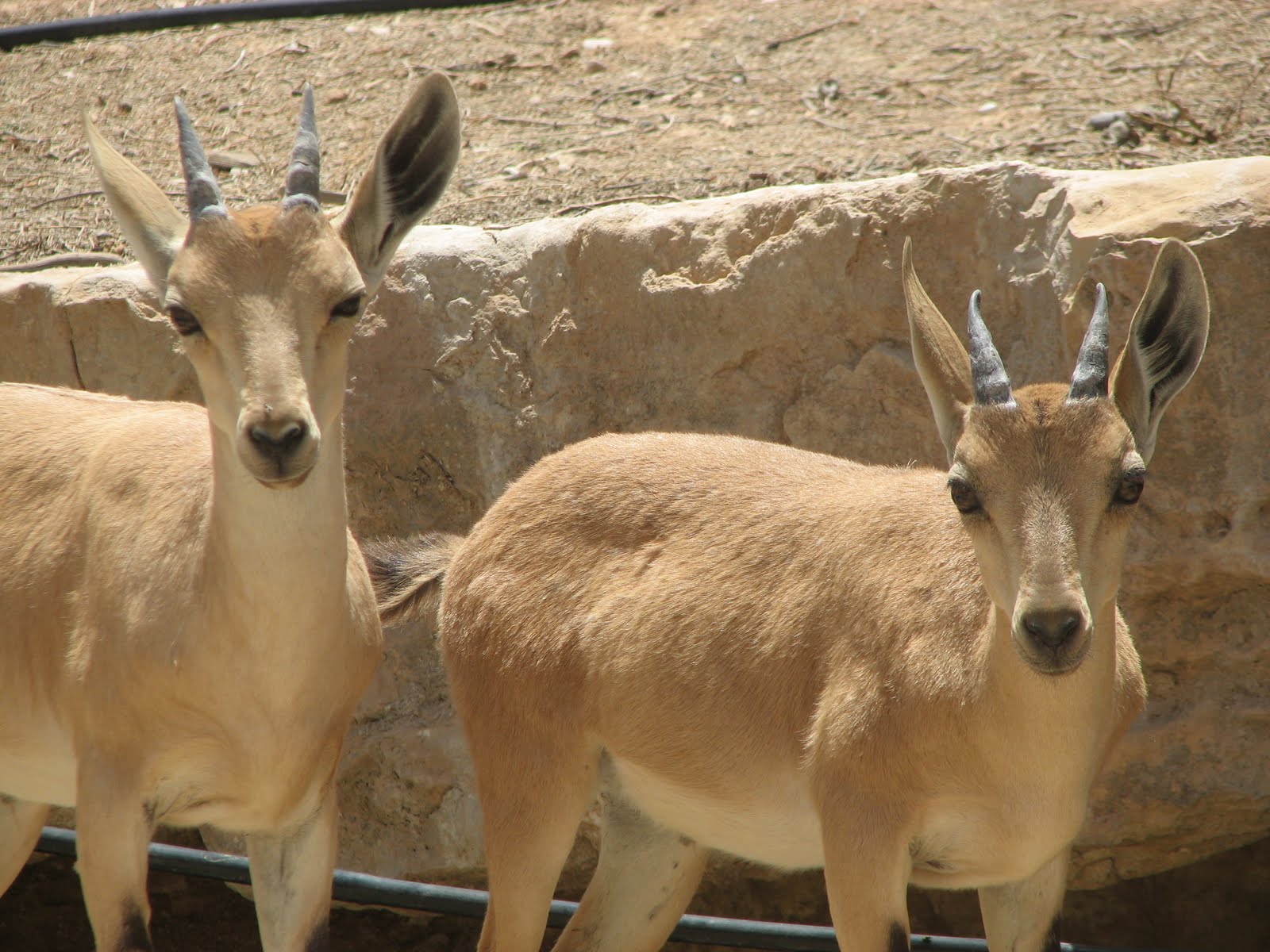
While some people were prepping lunch, I decided to walk over to Ben Gurion’s tomb since we were already there. Sadly, I never made it to the tomb. The reason is that we encountered a bunch of ibex. I spent some time photographing them and watching them, and decided to move on. And then I found a large ram with massive horns, so of course I stayed and watched him for a few minutes. Just a little further down the path, I found two females and their babies. I sat down on a rock to watch them and the babies slowly came closer to me over a period of about ten minutes. The moms did not seem happy about this, but they allowed it. They got within about five feet of me and posed wonderfully for the camera. It was awesome! At this point, I was perfectly prepared to skip supper and enjoy the wildlife. Unfortunately, a man from another group came walking down the path making a lot of noise and startled them. At that point, staying would have been a lost cause. It was awesome while it lasted though!

Two young ibex. Their mothers are up above them but watching me warily.

The youth hostel we stayed at in Arad was really nice. It even had a square in the middle with lots of beautiful plants. The food was exceptional and served family style. Sitting there eating such delicious food with several friends was a great experience. It was one of the biggest highlights of the whole trip for me! After supper, a group of us enjoyed exploring a little bit of Arad. We stumbled upon the bakery that Dr. Rasmussen had ordered our pitas from for the next day. We went inside, and found some fantastic pastries. Four shekels got me a cheese filled pastry and an apple filled pastry. They were fantastic. After that, we found the mall and wandered around it for a few minutes. It confirmed my opinion of malls. No matter where they are, they just don’t appeal to me. But, it was fun walking around a new city and seeing where the residents of that community shop. It was an exhausting, but fantastic day.

Thursday, June 24, 2010

Israel Day 9: Visitng the Negev


We stopped at a well preserved underground tomb. I don't remember the name of the location. This tomb has been restored with fresh plaster and paint.

We have spent the past three days traveling around the "deep south" of Israel. In that time, we visited the Negev, Mitzpe Ramon, the coast of the Mediterranean Sea in Ashkelon, and all the way to the Dead Sea near En Gedi and Qumran. Below is my impression report from the first day (June 22). I'll post reports for the other days sometime tomorrow.


One thing that I really enjoyed today was listening to Dr. Rasmussen discuss possible locations in the Elah Valley for the David and Goliath event. Not only did he discuss a couple of the possible locations, but we were able to see them. I have never really read Bible stories before and even really thought about the geography that is integral to these events. It had not occurred to me that the there are some clues given that can help locate a probable location of the event. It was also helpful to discuss why the location we had been instructed to mark on our map may not be the correct location. It was also fascinating to see just how far apart the opposing forces may have been. To have to yell and taunt across such a distance is quite impressive.

Lachish was interesting to me because I really didn’t know much about the location or the events that had transpired there. I had heard the name before a few times, but I couldn’t remember just why it was so important. It was fascinating to learn about how this location was such a poster child for Biblical archaeology. The fact that there is such a preponderance of evidence from not only different literary sources but from the archaeology itself is quite impressive. All of these various sources really come together to give an excellent view of the event. It was also amazing to me just how many pottery shards were on the ground. Dr. Richter had commented the week before about all of the pottery shards we were walking on, and all I saw were different rocks. After she spent a little bit of time explaining what to look for, they practically jumped out at me. It was fun to pick up various pieces of ancient pottery and look at them. It was even more awesome when she could tell us what part of a vessel it was such as the mouth, side, bottom, or handle piece. It’s amazing what you can learn from small pieces of pottery.

One of my favorite parts of the day was the visit to Ashkelon. I knew it was near the Mediterranean Sea, but I somehow missed that it was right there at the shore of it. I was excited about this for several reasons. First, I was pretty hungry and it was lunch time. Secondly, I figured it would be cooler that close to the water. Thankfully, this was the case. Thirdly, I had not been to the Mediterranean Sea before and I really wanted to swim in it. Sadly, this was not possible due to dangerous water conditions, but at least we still got to splash our feet in it. I enjoyed listening to Dr. Richter give a short talk on the archaeological dig process. The fact that she was doing this while we stood in front of an active dig site made it even more interesting. I also really enjoyed getting to see the massive gate up close. We had talked in class about how the Philistines used mud bricks in their construction. I was thrilled to get to see some original mud bricks up close. It’s hard to believe that these were all made by hand.

After visiting the antiquities for a little while, it was refreshing to be able to just walk down the beach and walk through a little bit of the surf. I really enjoyed getting to see some dead jelly fish. This may sound a bit morbid, but it was cool. The reason is that these jellyfish looked rather different from those that I’ve seen in Florida. They had much shorter tentacles. I need to look up what varieties occur in the Mediterranean Sea. I also enjoyed looking at the various seashells along the shore. The reason for this is that the shells were different from what I’ve seen in Florida and in Washington State. They tended to all be fairly small and quite uniform one to another. They were different sizes and colors, but they were mainly all the same shape.


This is standing on an overlook above the beach. We walked down to the beach later. Notice the how dirty the shirt is from crawling into a tomb. It might also be because I ate some ice cream that dripped...
The biggest highlight for me was when we arrived at the youth hostel in Mitzpe Ramon. I was expecting to be in a room with 12 other guys and that we’d have to use a communal bathroom two floors down. Instead, we were treated to having just three guys in a room with a private bathroom, air conditioning, and cable TV. This is far beyond what I had envisioned. On top of this, we were at an absolutely beautiful location at the Big Machtesh. I was not prepared for how large this thing is. It reminded me of looking down into the Grand Canyon. It was absolutely stunning.

A view of the Big Machtesh. This is also sometimes called the Super Bowl.

The last highlight of the day for me was walking through the town looking for the small grocery store. We finally found it, and were surprised at all the packed into there. One person described it as a “mini WalMart.” It was fun to spend some time exploring a small town outside of Jerusalem and see what all was there. As an added bonus, it was a great way to enjoy the cooler temperatures of the evening!

Me posing with some creepy statue located along a path the follows the rim of the Big Machtesh

Over all this day far exceeded any of my expectations. I’m so thankful that for the opportunity to so many different locations from the Bible and to experience the beauty of the land God created.

Sunset over the Big Machtesh. This photo does not do it justice